Meet the Wasti Family

Michael Wasti, also known as Mikko, Mekke and Mitchel in various records, was a native of Finland who emigrated to the United States in 1893.  By 1910 he had married Lena Puttika, also of a native of Finland and the couple had settled in Douglas, living on Mumford Street, (today known as B Street) Michael supported their growing family by working as an Axe Grinder in the local Axe Mill, a notoriously hazardous trade.  The census lists that Lena was by then the mother of 8, children, with 6 living– Jennie, Jacob, Elizabeth, Mary, Martha and Walter. She gave birth to the couple’s last daughter, Ida Amanda in February of 1912.  

One month later in March of 1912, Michael spent two weeks in the City Hospital in Worcester due to a growth on his side, however he recovered and was released. Unfortunately, on June 28th of 1912 he died of Tuberculosis of the lungs and intestines, a condition which he had suffered for about 2 years.  No doubt the fine filings he breathed at the axe shop didn’t help his overall health.

The couple’s youngest daughter Ida developed Dysentery on August 9, 1913 and died August 15, 1913, at the age of 1 year 6 mos.  In 1918 Their Daughter Mary like her father before her, was stricken with Tuberculosis and was sent to the State Infirmary in Tewksbury where she stayed for 2 months and 29 days before her death from TB and the Spanish Influenza, November 12, 1918.  Her body was returned to Douglas.  I do not find a record of Mary’s burial location other than “East Douglas”, but it is likely she joined her father and sister in Pine Grove. Neither of the girls appear to have a headstone*.

By 1918 Lena, lived on Cross Street, which is today called A Street, which is very close to the cemetery. On April 1st 1921 Lena was listed as one of 3 victims stricken with “Sleeping sickness” also known as Encephalitis Lethargica, or Epidemic Encephalitis, a mysterious often deadly illness that had been cropping up between the years 1916 and 1931, with no known cause.  Lena survived her illness, but it left her permanently disabled. Lena passed away of pneumonia four years later in 1925 at the age of 52.

Michael and Lena share a flat pink granite grave marker in Pine Grove, it was uncovered in May of 2019 after being buried by the dirt & grass for many years.  No marker is found for their daughters. Presently, it is not known whether one exists or if it was a flat marker and is there under the soil.

Jedediah Jepherson and his Memorial Pine Tree

Happy New Year Everyone,
Now that it’s 2026, the year we’ll celebrate America’s #250thAnniversary I’m going to start sharing some stories of our #revolutionarywar veterans.

Jedediah Jepherson and his Memorial Pine Tree –at South Douglas Cemetery

Jedediah was the son of Joseph Jepherson and Mehitable Cummings born September 19, 1758 in Gloucester, Providence, Rhode Island, British Colonial America.

Jedediah registered for military service in 1776. He was a private in Capt. Jonathan Carrier’s company, Col. Josiah Whitney’s regiment. His military service included three months, Camp at Hull, from August 1, 1776, to November 1, 1776, He also served an additional 1 month and 4 days in November 1776, including 75 Miles travelled home. He enlisted again on July 22, 1777 for six months.

He married twice, First to Susanna Emerson on 28 October 1781, in Uxbridge, MA and the couple went on to have several children. He later married Jerusha Cox and had two more children.

Before Jedediah’s death at age 86, he made a request of his friend and fellow soldier George Baker, instead of a stone memorial Jedediah simply wished that a tree be planted to mark his final resting place, saying “That is all the monument I want”. And so after he passed on July 23 1845 and was interred in the earth of South Douglas Cemetery, his wish was carried out and for more than 100 years the towering pine stood sentinel over the grave of Jedidiah Jepherson. It was described in the June 6, 1921 edition of the Worcester Telegram as being “very prominent with three parts branching out from a six foot trunk with a circumference of 14 feet.”
The article notes that one of Jedediah’s descendants was Lucius J Marsh. Sadly, the great memorial tree is no longer. Local Historian Lucius J Marsh Jr notes in his documentation of South Street and South Douglas Cemetery that the tree was removed sometime in the 1930s. I surmise this could possibly have been due to the widespread devastation caused throughout the town by the hurricane of 1938, or another reason. Today the exact location where the tree once stood– and therefore also that of the grave of Jedidiah is today unknown.

History by Lantern-Light

Pine Grove’s stories shared in an after-dark stroll

On October 24th and 25th we had the largest group of people to visit this cemetery in recent history, probably since the last funeral in 1977. We had 33 people attend tours of Pine Grove.

I couldn’t thank you all enough and I hope to host more community cemetery events such as this.

A well-visited cemetery is a well-cared for one. Together we are the caretakers and keepers of this history.

Tale of The Haunted Apple Tree

Tales of early Douglas tell of A Haunted Apple tree, whose apples were stained red from skin to core by the spilled blood of a peddler who had been murdered after taking a rest at the base of the apple tree. The story, titled “A Peddler’s Spirit Pursued his Slayer” was included in a collection of snippets called Haunted Houses of New England by Samuel S. Kingdon which appeared in a the July 1900 issue of A Ladies Home Journal.

So pervasive was the telling of this tale in the history of Douglas that it is even mentioned in the text of They Raced Horses on Main Street, where Anthony Coppola records an Excerpt from a Local Wedding, the passage goes as follows:

“The merriment was kept up until the older married people were sleeping to be awakened some hours later by a doleful sound which might have been the mourn of the spirit of the peddler who was murdered in the haunted orchard many years ago.”

Excerpt From a Local Wedding, They Raced Horses on Main Street.

I recalled having come across a mention of said a Haunted Orchard about a year or so ago while researching a deed. The deed, recorded August 23, 1906 granted a piece of land in the area of Depot Street from William Wellman to The Worcester & Providence Street Railway Co. The land is described as “a certain strip or parcel of land situated in the town of Douglas about one mile south easterly from the village at East Douglas at The Haunted Orchard Pond, so called.”

A later retelling of the Tale by Charlotte Coppola caught my attention at the Douglas Historical Society’s Octoberfest Exhibit, which featured a newspaper article in which she mentions a few more details which were not in the prior versions of the story I had encountered.

Charlotte Copolla’s version mentions several details more including that the year was 1751, that the Orchard was on Martin Road and that The peddler had come from Providence, RI before meeting his fate in Douglas. As the story goes so troubling to travelers was the haunting, which appeared to beckon them with one hand outstretched and the other held over the throat, that they actually moved the road to avoid passing by the Orchard at night.

It is noteworthy that locations in this area still bear names such as “Orchard Place” (a neighborhood and street named October 2, 1939) at the junction of Depot and Martin Roads, and that a brook called Wellman Brook runs from an unnamed body of water that appears on current maps near Martin Road. Could this be the pond described in the deed of William Wellman called Haunted Orchard Pond?

Could such a spectral tree have existed?

I decided to look a little deeper into whether such red fleshed apples exist and to my pleasant surprise it turns out that they do. Though according to most sources, red fleshed apple cultivars are fairly recent result of intentional apple tree grafting. Is it possible that such a tree could have existed in 1751?, if not by the blood of a peddler then by a genetic variant of the apple tree itself?

According to Salon.com’s article Red Fleshed Apples: The Science Behind an Uncommon and Much Desired Apple Breed,

The presence of red flesh in apple cultivars is caused by the MYB10 gene, a localized genetic protein and transcription factor for anthocyanin pathways. Anthocyanins — which are a type of water-soluble polyphenolic pigment — give fruits and vegetables their signature shades of red, purple, blue or black.

Treesofantiquity.com offers a variety called Burford Red Flesh which originates in Georgia in the 1800s, according to the site. This variety is hardy in zones 5-9.

That concludes our tale, dear readers! Enjoy your autumn,

S.B.C.G

The Eternal Residents of Pine Grove.

“What’s the Matter With East Douglas? She’s Alright, You Bet.”

A charming “pennant” postcard stops me as I’m scrolling through eBay listings of “Douglas, Massachusetts” related items. I smile at the hand written “You Bet” penned on to the printed greeting, and click “buy it now”.

The card comes home to where it started from. Mailed in 1912, the Postmark itself curiously bares “Douglass” with a double ‘s’, though the word Douglas on the pennant has only one ‘s’. The card carries a message to “Edward Balcome” all the way up in Eagle, Alaska.

It reads “Did not want you to forget East Douglas, and to know that we are alive here — Eddie — we will have some good times when you are back– 1914 is a great year you understand — and with H.D.C. who is my dearest friend — we four — can have some good times — We will make up this lost time — Just look forward to the year you are back– was talking over the phone with Helen — to-night.

Best of wishes, Mary K. F

I wondered what brought Mr. Balcom to Alaska, or what his relationship to Mary was. I quickly typed his name into “familysearch.org”. No hits for Eagle Alaska, but in Douglas his name does indeed appear– in a marriage record, recorded in the Town of Douglas in 1915, where he married Helen Delia Church, or “H.D.C”, on the 12th of April. Apparently Mary’s prediction of the good times that awaited him on his return were correct. Edward and Helen, Mary’s dearest friend, married in 1915, had a child in 1917, and returned to Douglas from Hartford, Connecticut to raise their family in 1928. The husband and wife share a family plot in Douglas Center Cemetery, where their son Raymond Douglas is laid to rest also.

Descendants of Helen and Edward Balcom include granddaughters, Elizabeth L. Balcom of Cambridge, MA Cynthia A. Balcom of Cumberland Gap, Tenn., and Susan LaRose of Webster, MA.

If any decendant of Edward Herbert Balcom wishes to claim the postcard, it would be my pleasure to return it to the keeping of the family.

SBCG,

The Eternal Residents of Pine Grove.

The Eternal Residents of Pine Grove Salutes Our Veterans:

The Eternal Residents of Pine Grove recognizes and honors our interred Veterans:

Americam Civil War:

Leander Andrews—  51st MA Infantry, Co. I  d.1874

Charles F. Balcome—  51st MA Vol. Co. I d. 1887

Kennedy Brunnock— 15th, 36th, 25th MA Infantry, Vol. on the quota for Douglas, MA.  (May be buried in this Pine Grove (unmarked) or another as it was not specified.)

Samuel Cragin— 3rd Cav. RI Co. G  & 25th MA Infantry Co. D, Vol. d. 1892.  Headstone raised and reset August 25, 2018.

Joshua Dubuque— 25th MA Infantry Co. E  d. 1866

Burton Goddard— 12th CT Infantry Co. H. (d. 1907)

John “JNO” Holland–12th CT Infantry Co. H. d. 1895

William S. Reynolds— 30th Unattached MA Heavy Artillery.

Samuel Sibley— 15th MA Infantry Co. H died from wounds received in battle, Ball’s Bluff. Died and was buried in Poolsville, MD. Pine Grove Headstone is believed to be a Cenotaph.

Charles Walls— 1st MA Cav. & 25th MA Infantry Co. D  d. 1887

Luther White— 18th CT Reg. Vol. Co. D d. 1865 in Annapolis, MD after being taken P.O.W.

World War I :

Walter C. Hughes  Veteran of W.W. I.    d. 1970

as well as those interred elsewhere, those who have served and are currently serving…

Thank you for Your Service!

**This is in no way a complete list, but a work in progress.  If you know of a Veteran whose final resting place is in Pine Grove Cemetery, Douglas, MA, please leave me a comment or message with that information, and I will happily add them to my list.

A Murder at Mid-day: A note from Lemuel Healy, Town Clerk of Dudley MA, 1856


Few things quicken the heart of history lovers more than a well-kept record. Meticulous in his penmanship and dutiful in the details of his death records, Lemuel Healy the town clerk of nearby Dudley, Massachusetts is a history lovers’ best friend.

healyheader


Lemuelhealy
Dudley Town Clerk of Old, Lemuel Healy. (Source: Chris Child, Findagrave.com)

So thorough was he, that he was compelled to include in his record, an account of a murder which occurred in his town, even though the victim succumbed to his injuries elsewhere.

His account is so well written it would be a shame to let it slip between the pages of history unnoticed.  So here The Eternal Residents of Pine Grove, in appreciation to his dedication to his office, presents to you his account.  Found on the reverse side of a sheet in his record book, with all his neatly written columns.  he leaves us the following:

healymurdernote

We can truly say there has been 3 murders committed in the town this past year.  The one (besides the the  two Naughtons here-in recorded) was shot in the head by his companion who was riding in a buggy with him at mid-day, & within 50 rods of the centre of the town and vilage.  Although two pistol balls being lodged from 4 to 5 inches into the back of his (Flashman’s) head, he survived till the third day, and died in Webster at his own home where he had been carried. — Doing too large business in this line in one year, in a small town whose population is not 1500. ~

Sure enough the records of neighboring town of Webster, MA reflect the death of Mr.  Samuel Flashman, recorded as occurring in the town on December 26, 1856.  His cause of death is simply written as “Pistol shot”.  The record indicates that he was occupied as a trader, and that his body was removed to New York for burial.  He was 32 years old.


webster

Our gratitude to Town Clerk Lemuel Healy, whose eternal resting place is Villiage Cemetery in Dudley MA.  His beautiful handwriting, and intriguing account give us a unique glimpse into the past.   May he, and our subject, Mr. Flashman, both rest in peace.


(Special thanks to findagravemember Chris Child, for the portrait of Healy.)

“Our Darling Herbert”

The smallest marble obelisk in Pine Grove Cemetery in East Douglas, stands at just over a foot tall, with a peaked top and four sides, the westward face of which bares a simple 3 word inscription.

It gives no last name, no parents names and no birth and death dates– it simply reads “Our Darling Herbert”.

herbertbalcome

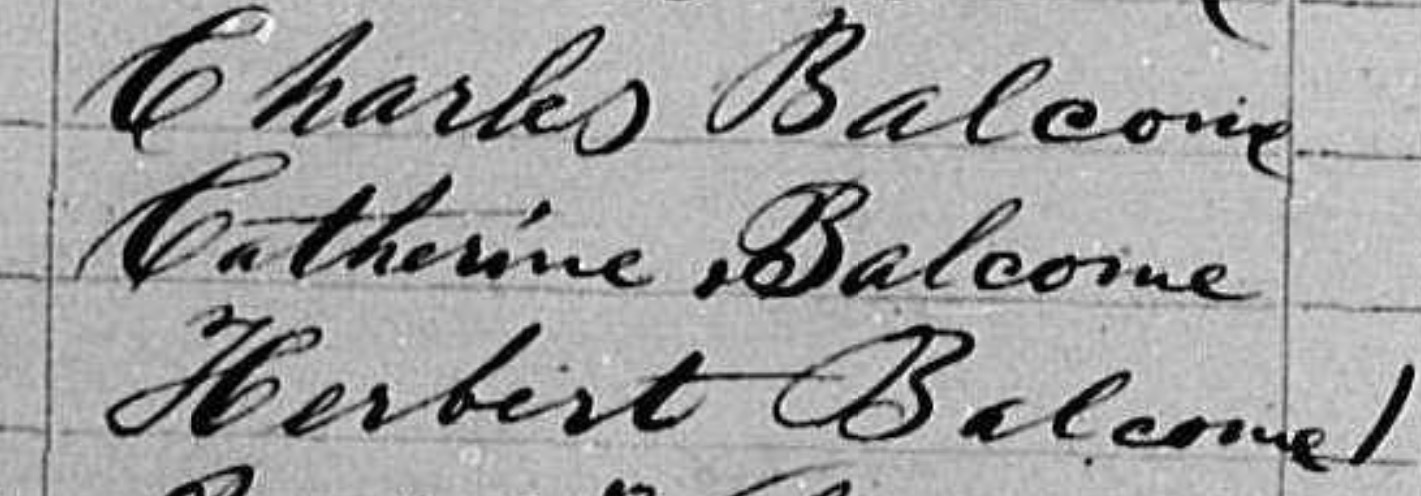
The little obelisk stands at the end of a row, closest to Catherine Balcome and her husband Charles Balcome.

It took some searching but on the census of 1855 we find the young family: Charles, Catherine and little Herbert, with a check mark in the column indicating that he was a child “under age 5”.

census

During the later part of the nineteenth century infant and child mortality rates were terrifyingly high. According to The Fatal Years: Child Mortality in Late Nineteenth Century America “Nearly two out of every ten children died before reaching their fifth birthday.” A staggering statistic that is reflected in the number of children’s graves we find in every historic cemetery across the nation, and Pine Grove is no exception.

Herbert’s parents Charles and Catherine would go on to have 4 other Children, Henry born in 1856, Pollie born in 1859, Ernest born in 1861 and Cora born in 1865, according to the Massachusetts Census of 1865, notably Herbert’s name is absent.

Catherine Ballou Balcome would pass away the following year, in May of 1866, at the age of 38. Her cause of death was listed as miscarriage. Her husband Charles F. Balcome, a veteran of the Civil War would join her and Herbert in eternal rest at Pine Grove in 1887 at the age of 61, his cause of death was listed as epilepsy.

The Balcome’s have nearly identical headstones, each a marble tablet atop a base. Both are grayed and covered in lichens. It should be noted that their headstones suffer from iron pin erosion. The iron pins, originally intended to add stability to this type of headstone, over the years have oxidized causing them to rust, and to deteriorate the stone from the inside out. Current preservation standards recommend that these type of iron pins be removed.

charlesbalcome
The headstone of Charles Balcome, showing iron pin erosion at the base.

The Lady of the House: The Eternal Residents of Pine Grove Remembers Philomene Donais Mercier

Although interred elsewhere, The Eternal Residents of Pine Grove recognizes and remembers Philomene Donais Mercier on this day, the 106th anniversary of her passing.

Philomene Donais Mercier was born in Canada in 1843, the daughter of Olive and Jean B Donais. She married Charles Mercier, a fellow French Canadian some years her senior.

Charles would become known to local history as one of Douglas’ prominent politicians who ran illegal liquor in the house where I now live during the town’s “dry” years.

Although officially recorded as “The Charles Mercier House” in Douglas’ register of historic Properties compiled in 1989, the family’s Second Empire style home on A Street is recorded in an 1875 deed as being sold to Philomene Mercier, specifically “without the control of her husband Charles”. It was she who purchased the house from James Wixtead at the cost of 825 dollars.

Earlier deeds to the house and land describe the property as being located near “The Congregation’s new burying ground” Today what we know as Pine Grove Cemetery, which opened officially in 1836.

Together the Mercier’s had one child, a son whom they named Charles after his father. Tragedy would strike the Mercier House in January of 1872 as little Charles was taken ill, and succumed to Scarlet Fever at the age of 1 year, 10 mos and 24 days.

His parents grief for their only child must have been great, as is evident by the lavishness of the not one, but two memorials that mark his eternal resting place. One of the monuments is among the tallest obelisks in St. Denis Cemetery, the other beside it, a tiny intricately carved lamb sits atop a marble stone inscribed in French and Latin.

Philomene and Charles remained together in the house, and some historical documents indicate that Charles was responsible for adding the Second Empire Addition to the house that same year, after the passing of his little boy.

Nothing is known of the details, but somewhere between the census of 1910 and her death in 1912 Philomene Mercier left Douglas without her husband Charles, and moved in with the Rock family in Worcester.

Philomene, the lady of the house, was found dead at thier home where she was living on November 5, 1912. Her cause of death was kidney failure and heart disease, she was 65 years old.

We can only assume by the tone of her will and the fact that she was not brought home to the family plot in Douglas, that she and Charles must have had a falling out. (Though being devout Catholics they remained married, but were clearly living seprately.)

Philomene left one third of her estate to her husband Charles, the rest to the Rock family with whom she resided at the time of her death, and of course, some to her church– Notre Dame des Canadiens, sadly demolished this year in Worcester.

In Philomene Mercier’s Last Will & Testament, (signed in the same “x” as her deed as she neither wrote nor read English) she directed that over her grave should be erected a monument in her memory to cost between $150 – $200, today the equivalent of about 3,000. Sadly, it seems that today, either her wish was never honored or her stone has since been removed.

She is buried in the St. Joseph section of Notre Dame des Canadiens Cemetery in Worcester. Interestingly the cemetery records incorrectly list her internment as being “Charles Mercier”, though the undertaker’s records confirm it is she who was laid to rest there. Charles Mercier who died in 1920 in Woonsocket, RI shares the plot with thier son in St. Denis.

Her grave is unmarked, only a newer granite stone for the Rock family (the same family with whom Philomene was living at the time of her death) stands.

Philomene Donais Mercier, you are not forgotten. Rest in peace, my lady.

The Sacrifice of War: The Heart-wrenching Story of Luther White

In 2013 A tin-type photo encased in a intricately engraved metal frame holding the only known photo of Luther White surfaced on Ebay. In the portrait, undoubtedly once a cherished family memento, he looks out at us from the glass, his expression stern for a man of his youth. His cheeks are hand colored to a rosy pink hue in an otherwise grey photo. The brass buttons on his jacket and the cap he wears show that this was a portrait taken just before the young man headed off to war.

lutherwhite

As the Civil War divided the nation, Luther White, left his young wife Sarah A. (Dearth) White, and joined into service enlisting on August 8, 1862 and mustering into service with Company D 18th Regiment Connecticut, Infantry, Volunteer.

On June 6, 1864 just five days before his infant son would be born back home, the young union soldier was wounded and taken prisoner of war in Piedmont, VA. He was eventually exchanged with hopes of returning home to reunite with his family, but as fate would have it Luther White, then just 22 years old, passed away in Annapolis, MD on March 14, 1865– a little less than 2 months shy of the war’s end.

He was finally brought home and laid to rest in East Douglas’ Pine Grove Cemetery, beside his mother Arvilla who died shortly after his birth in 1842. He was the only son of his parents. His father, Martin White, Jr would join them there in eternal rest in 1888.

A beautifully written obituary nothing short of poetic, penned by one W. Wilke who attended the young man’s funeral, appeared in Print in East Douglas April 20, 1865.

From it we learn the true cruelties of wartime, as it describes Luther’s cause of death as “exposure” and starvation, it tells also that Luther left behind “a little boy too young to know it’s loss, upon whose form the father never gazed.” His infant son Luther E. White.

His grave is marked with an ornate white marble stone, with a convex oval face crowned by a wreath of flowers carved in relief. The stone, much like a broken heart is cracked in two pieces, one leaning upon the other for support.

luther


Source of Obituary and Portrait, Find a Grave: https://www.findagrave.com/memorial/49521280/luther-white with special thanks to FindaGrave Contributor “Jessicado”. Enlistment details from Civil War Research Data base, and 3fold.com.  updated 30th December to correct, and add new information.